E-Invoicing Made Easy for Hotels in Malaysia: Booking Scenarios, Rules and Common Mistake
The Malaysian hospitality industry is entering one of its biggest operational shifts with the rollout of E-Invoicing. As Phase 4 gets closer in January 2026, hotels across the country are beginning to feel the impact. Hotels handle a high volume of transactions every day, including room bookings, walk in guests, corporate stays, government travellers, F&B outlets, spa services, retail counters, banquets, OTA reservations and event billings. Each transaction type is different and requires a specific E-Invoice handling method. This makes compliance far more challenging for hotels compared to ordinary businesses.
Because of this, many hoteliers are asking the same questions.
“What if a guest requests an E-Invoice, what should I do”
“What is considered a booking from an OTA and how should it be handled”
“What E-Invoice type should be used for travel agent bookings”
These questions show how much confusion still exists in the market. This blog is written to clear that confusion by explaining E-Invoicing specifically for hotel operations. It covers the basics, the required information and the correct E-Invoice type for each hotel scenario. By the end, front office teams, finance departments and hotel managers will have a clear understanding of how to stay compliant as Malaysia moves fully into the E-Invoice era.
Understanding What Is E-Invoicing
E-Invoice is a digital document that is created and submitted electronically to the LHDN MyInvois portal for validation. Once the invoice is submitted, the system checks the details and approves the document. The system then generates a unique validation link together with a QR code. This QR code serves as the official proof that the invoice has been validated by the government.

For a quick understanding, you may refer to the LHDN infographic here:
https://www.hasil.gov.my/en/e-invoice/communication-and-publicity/infographic/e-invois-hasil-info/
Types of E-Invoices in Malaysia
Malaysia recognises several types of E-Invoice documents. Hotels must understand these types because each transaction category may require a different document. The main types are Standard Invoice, Credit Note, Debit Note, Self Billed Invoice and Consolidated Invoice.
A Standard Invoice is used for most normal transactions such as room stays or F and B purchases. A Credit Note is issued when the hotel needs to reduce an invoice value, for example when giving a refund or correcting an overcharge. A Debit Note is used when the hotel needs to increase the value of an invoice. A Self Billed Invoice is created when the customer, rather than the supplier, is responsible for issuing the invoice. A Consolidated e-Invoice is used for grouped transactions such as daily cash sales or OTA payout amounts.

More details can be found here:
https://www.hasil.gov.my/media/wvuhp2ro/20240509-info-on-e-invoice-implementation-vol-1-en.jpg

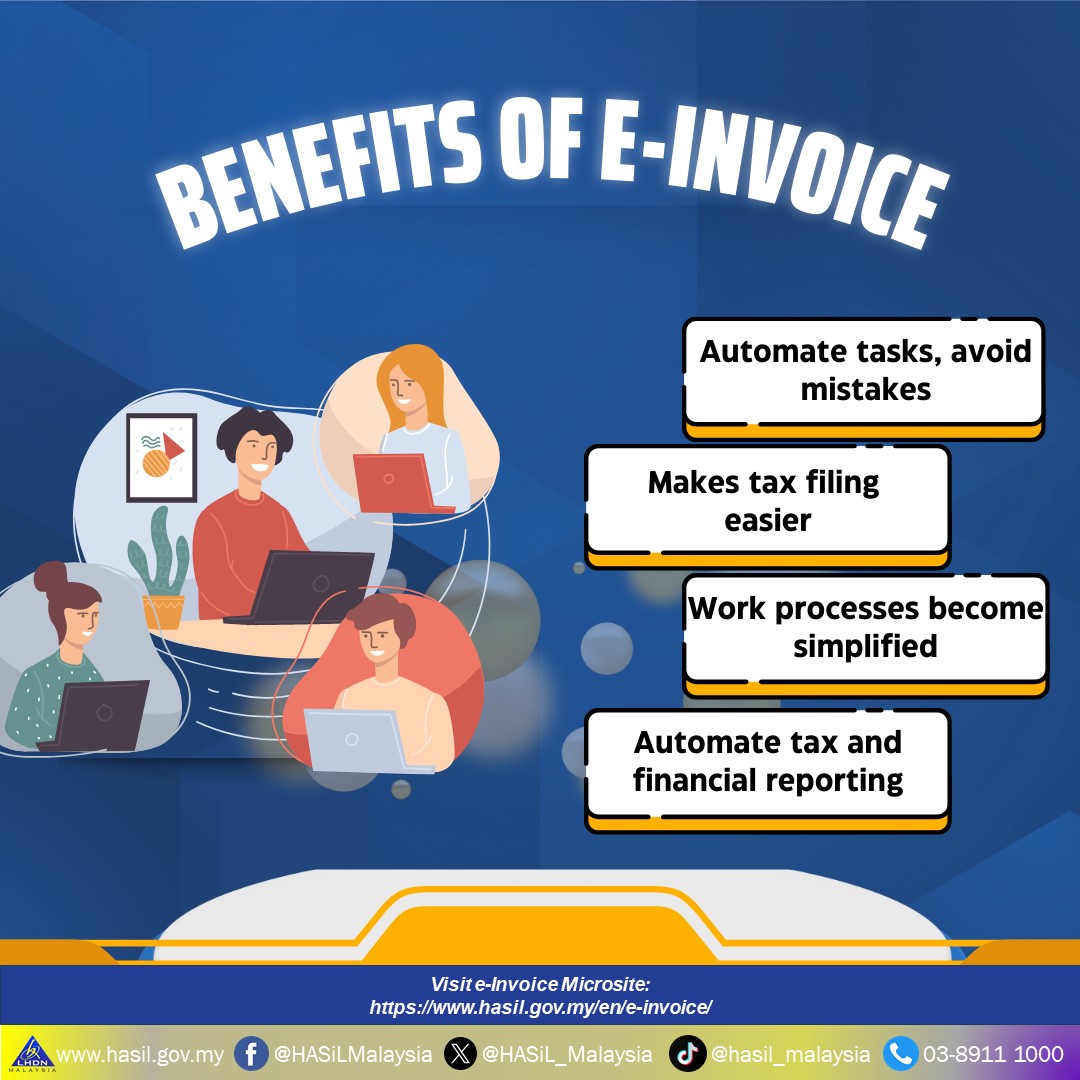
Benefits of E-Invoicing for Hotels
E-Invoicing brings many advantages to hotels and other businesses in Malaysia. One of the main benefits is improved accuracy. Since all invoice data is sent directly to the MyInvois system, the chances of producing duplicate or incorrect invoices are much lower. This helps hotels maintain accurate financial records. E-Invoicing also increases transparency because every validated invoice contains a QR code that proves it has been submitted to LHDN. This builds trust with guests and corporate clients.
Another benefit is faster processing. Hotels often deal with heavy check in and check out activity each day. E-Invoicing helps speed up billing and reduces manual mistakes. For finance teams, reconciliation becomes easier because all transactions follow a standard digital structure. Audit readiness also improves because validated documents are stored safely and can be retrieved instantly.
E-Invoicing also supports digital transformation in hotels. By integrating PMS and POS systems with an E-Invoice solution such as eZee QuickBill, hotels reduce paperwork and improve productivity. This leads to smoother operations and a better guest experience.

More information is available here:
https://www.hasil.gov.my/media/tkhlhirx/2-benefits-of-e-invoice.jpg
E-Invoicing for Common Hotel Scenarios
The hotel industry deals with many different booking sources every day. Each booking source has a different relationship between the seller, the buyer and the party responsible for payment. Because of this, the E-Invoice requirement for each booking type is also different. Understanding these differences helps front office, finance and reservation teams avoid mistakes and stay fully compliant with LHDN guidelines.
The scenarios below are based on the most common booking sources used by hotels in Malaysia, including OTAs, direct bookings, travel agents, individual agents and government agencies.
-
Walk In Guests
Walk in guests are treated as retail customers. The hotel should issue a Standard E-Invoice at check out. Guest information such as name and email should be captured. A TIN number is optional unless the guest requests it.
-
OTA Prepaid Booking (B2C)
In a prepaid OTA booking, the guest pays the OTA in advance. The OTA then pays the hotel separately in a payout cycle. Since most global OTAs do not have a registered company in Malaysia, the hotel should not issue an E-Invoice to the guest. Instead, the guest must submit a self billed E-Invoice on the MyInvois portal if they require an official document for tax purposes. The hotel will only issue a Consolidated E-Invoice for the payout received from the OTA.
-
OTA Postpaid Booking (Pay at Hotel) (B2C)
In this case, the guest pays the hotel directly upon check in or check out. The hotel is fully responsible for collecting payment, therefore the hotel must submit a Standard E-Invoice to the guest. Why: The hotel receives the payment, so it becomes the seller in the transaction.
-
Direct Booking (Walk In or Hotel Website) (B2C)
This is the simplest scenario. The hotel collects payment directly, so the hotel must submit a Standard E-Invoice to the guest. This applies to walk ins, hotel website bookings or bookings made through the reservation department.
-
Local Travel Agent Booking (B2B)
When the travel agent is a Malaysian registered business with a TIN, the hotel must issue a Standard E-Invoice to the travel agent. The travel agent will then invoice their own customer separately.
Action for hotel: Submit Standard E-Invoice to travel agent.
Why: The hotel is responsible for collecting payment from the travel agent or issuing credit terms based on contract.
-
Commission Based Individual Agent (B2B)
In this situation, the individual agent is the seller because they refer business to the hotel and receive commission. The hotel is the buyer because the hotel pays the commission.
Two invoices are involved here:
- Hotel issues a Standard E-Invoice to the guest. This is for the room or stay charges.
- Hotel submits a Self Billed Invoice for the agent commission. This proves that the hotel is paying commission to the agent and ensures proper reporting to LHDN.
- Government Agency Booking (B2G)
Government agencies in Malaysia do not have individual TIN numbers. Hotels must use the general government TIN provided by LHDN. For example: E10000000040 for federal government agencies.Hotel need to submit Standard E-Invoice to government agency using the general TIN.
Why: Hotel is responsible for providing official documentation for government payment claims.

Common E-Invoice Mistakes Hotels Make
Many hotels in Malaysia are still adjusting to the E-Invoice requirements and this has led to a number of repeated mistakes across front office, finance and F and B operations. Understanding these mistakes early can prevent delays, rejected invoices and confusion during audits.
One of the most common mistakes is issuing an E-Invoice to OTA guests. Since most OTAs operate from overseas and are not registered under LHDN, hotels should not invoice the guest. The guest must self bill and the hotel should only issue a consolidated invoice for the OTA payout. This mistake still happens because some teams do not fully understand the rule.
Another common mistake is missing or incorrect TIN. This usually happens with corporate or government guests because the details are not collected during reservation. Wrong TIN or wrong participant type will lead to invoice rejection. Hotels must ensure data collection processes are consistent and accurate.
Hotels also sometimes use the wrong E-Invoice type. Examples include using Standard Invoice instead of Consolidated Invoice for daily cash sales or forgetting to use Debit or Credit Notes for invoice adjustments. Errors like these affect reporting accuracy and daily reconciliation.
Some properties also fail to perform amendments within the allowed 72 hour period. If the correction window is missed, the only option is to issue a Debit or Credit Note. Staff need to be trained to act quickly whenever corrections are required.
Finally, many hotels still do not integrate their PMS and POS with an E-Invoice system. Without proper integration, staff may send invoices manually which increases the chance of mistakes and slows down the workflow.
By avoiding these mistakes, hotels can achieve smoother E-Invoice compliance and reduce operational stress.