
Mastering Malaysia’s E-Invoicing: A Critical LHDN Compliance Guide for Malaysian Hotels
The digital transformation of tax administration is rapidly accelerating across Malaysia, spearheaded by the LHDN e-Invoicing mandate. For the hospitality sector, this shift is not just about moving from paper to PDF; it’s about adopting a real-time, data-driven framework that fundamentally alters how sales and expenses are recorded. Hotels and resorts falling under various revenue thresholds must prepare, as implementation phases stretch toward January 2026.
This guide details the critical steps and unique scenarios Malaysian hotels must master to ensure smooth e-Invoicing compliance and avoid operational disruption.
Understanding the E-Invoice Basics and Hotel Classifications
An e-Invoice is defined as a digital document submitted to the LHDN MyInvois system in real-time. It contains detailed transaction, buyer, and seller information, serving as crucial proof of incoming sales and expenses. This process is regulated by the LHDN and replaces traditional manual paper documents.
Hotels must be prepared to issue four primary documents as e-Invoices: Invoices, Credit Notes (CN), Debit Notes (DN), and Refund Notes, as well as their self-billed counterparts.
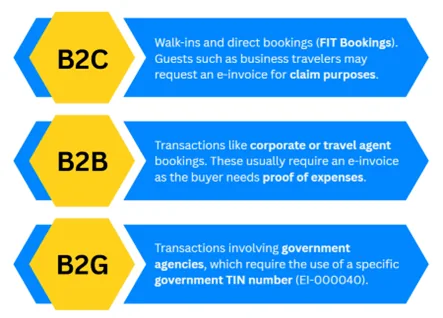
In the hospitality industry, transactions generally fall into three categories:
Mastering Unique Hotel Scenarios: Consolidated and Self-Billed E-Invoice
The high volume of consumer transactions and reliance on foreign partners require hotels to master two special compliance mechanisms:
1. The Consolidated E-Invoice
For standard B2C transactions where the guest does not request an e-invoice, the hotel still needs to declare these sales to the LHDN. These individual transactions must be aggregated and submitted as a Consolidated E-Invoice. The hotel must submit this consolidated report by the 7th day of the following month for all previous month’s non-e-invoiced transactions. When submitting this consolidated report, the hotel uses the General Public TIN (EI-000010) as the customer identifier.
It is important to note that certain activities, such as sales over RM10,000 in a single receipt, are not allowed to be consolidated and must be issued as individual e-invoices.
2. The Self-Billed E-Invoice
This is essential when the hotel needs to record payments or commissions paid to a supplier (like a foreign Online Travel Agent or OTA) who is not locally registered in Malaysia and therefore cannot issue a Malaysian e-invoice (lacking a TIN).
The hotel, as the buyer, generates the self-billed e-invoice on behalf of the supplier to prove its own expenses (such as the commission). This is also applicable when acquiring goods or services from individual taxpayers (like an individual landlord) or paying commissions to agents/dealers.
The Step-by-Step E-Invoice Flow: From Checkout to Validation
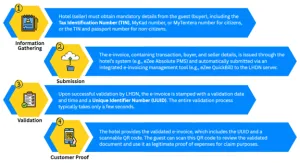
An e-invoice is not a PDF; it is structured digital data generated from a system and submitted to the LHDN MyInvois system. The flow begins at the moment a guest checks out and requests an e-invoice:
Correction Scenarios: Cancellation vs. Adjustments
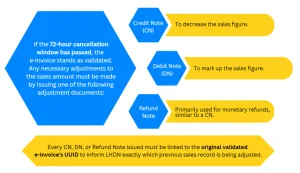
Crucially, once an e-invoice is submitted and validated, it cannot be modified, edited, or deleted.
Corrections must follow strict protocols based on the timing of the error detection:
1.Cancellation (Within 72 Hours)
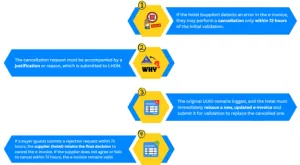
2. Adjustments (After 72 Hours)
The Adaptation Strategy: Automation and Self-Service
For large-scale operations like hotels, manual data entry for e-invoicing is unsustainable. The essential adaptation strategy involves automation:
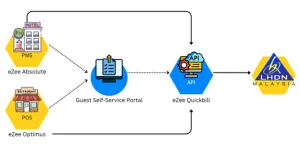
- System Integration: Hotels must ensure their Property Management System (PMS) (like eZee Absolute) integrates seamlessly with an e-Invoicing management tool (like eZee QuickBill) to automatically transfer transaction data to the LHDN system.
- Guest Self-Service Portal: To accurately gather mandatory buyer information, hotels can utilize a Guest Self-Service Portal. Guests can scan a QR code (often printed on the normal invoice) to access the portal and input or correct crucial billing details, such as their TIN or Identification Number, streamlining the staff’s compliance duties before submission to LHDN.